

THANK YOU FOR SUBSCRIBING


 Michael Arnouse, President and CEO
Headquartered in Port Washington, New York, with offices on both coasts, ADDC was founded in 2002 by Michael Arnouse. Since then, the company has been a trailblazer in the edge computing space—long before it became a buzzword.
“What we offer isn’t just smaller and more efficient— it’s smarter and more secure,” says Michael Arnouse, President and CEO.
 As businesses increasingly rely on cloud services, the demand for robust, efficient solutions grows. Rising energy costs, expanding security vulnerabilities, and mounting environmental pressures place traditional hardware under immense strain. This can slow operations and expose organizations to significant risks. ADDC’s solutions are specifically designed to tackle these challenges, safeguarding data, optimizing energy use, and ensuring operational control even in the harshest conditions.
A Big Idea in a Small Package
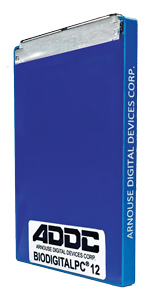
At the core of ADDC’s innovation is the BioDigitalPC®—a fully functional, credit card-sized x86-64 computer. Representing a paradigm shift in edge computing, this tiny powerhouse packs an impressive punch with Intel i7 quadcore processors, 32GB of DDR4 RAM, and 1TB of NVMe self-encrypting storage. Encased in a proprietary epoxy material, the BioDigitalPC® is tamper-proof, waterproof, dustproof, and free from the constraints of legacy cooling systems.
This pluggable device is hot-swappable and designed to perform in environments that would incapacitate traditional systems. With an operational range from -40°C to 70°C, the BioDigitalPC® eliminates the physical vulnerabilities of conventional computers and servers, earning NIST FIPS 140-2 Level 3 validation for its security.

We are the smallest and most secure computer on the market—literally the size of a credit card.
 “We are the smallest and most secure computer on the market—literally the size of a credit card,” says Arnouse. “It’s a full-powered edge computing unit, a server, a mobile computer—whatever you need it to be. And it uses just 10 percent of the power of a legacy system.”
Amazing Potential for Commercial Use Cases
While the BioDigitalPC® has found success powering mission-critical systems in military applications, it is now making significant strides in the commercial sector. “We’ve had great success with defense applications, but now we’re bringing the same advantages—low power consumption, ultra-small footprint, and high security—to enterprise customers,” says Arnouse. The same technology trusted by elite Special Forces and military aircraft is now being leveraged to deliver powerful, secure solutions to industries where downtime and compromise are simply not options.
The widespread shift to cloud computing has introduced new vulnerabilities, including outages, cyberattacks, and latency spikes, which can disrupt operations that rely on remote servers. ADDC takes a different approach. Its edge-first philosophy ensures that computing power remains close to the point of need, allowing essential operations to continue even when cloud connectivity is lost. This resilience can be the difference between a minor inconvenience and a catastrophic failure for sectors like healthcare, finance, manufacturing, and logistics. “Our edge data centers bring cloud-level performance to the edge, ensuring business continuity during internet outages. This gives companies a reliable, self-contained sovereign solution for their operations,” says Arnouse.
Localized Data Centers at the Edge
ADDC’s products make it possible for small offices, remote sites, or even storage closets to support processing stacks that once required dedicated rooms and cooling infrastructure. This reduces reliance on third-party cloud providers, keeping critical operations closer to home and improving both performance and cost-efficiency.
This efficiency is especially crucial in today’s data-driven world, where network interruptions or security breaches can bring operations to a halt. Arnouse sees ADDC’s role as providing a resilient, on-premises alternative to cloud reliance, mitigating these risks with virtually no downtime.
Remote Desktop Infrastructure (RDI) for Sensitive Industries
It’s not just the defense sector that demands stringent data security. ADDC’s products are gaining traction in industries where confidentiality is critical.
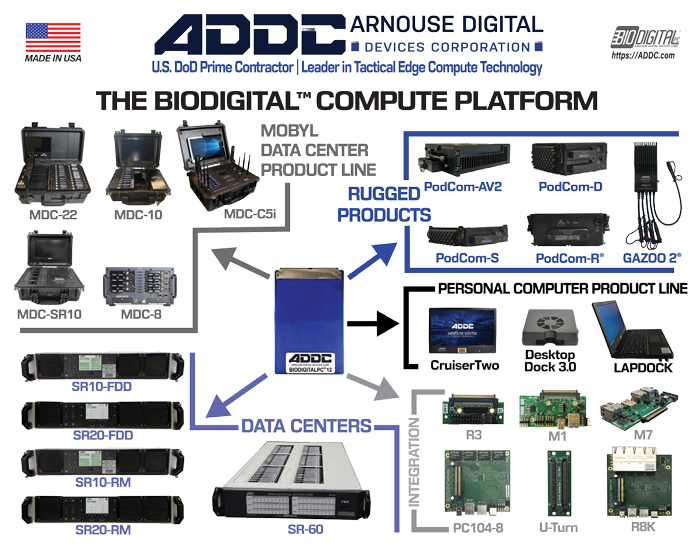
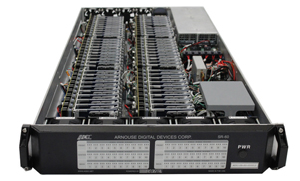
The company’s Bare Metal fiber optic zero client solution addresses the most common computing security risks—local data storage and interception. Pairing the SR20-FDD server (capable of hosting 20 BioDigitalPC® Compute Cards) with the zRex desktop terminal “is the answer to today’s cybersecurity challenges,” says Arnouse. “Unlike traditional setups, there’s no data on the endpoint device. It’s just a display, keyboard, and mouse. Even if someone steals it, there’s nothing to extract. That’s peace of mind for industries like finance, healthcare, legal, and any sector dealing with sensitive data.” In addition, the Zero Client solution supports secure desktop fiber optic wired environments up to 25 miles away, with TEMPEST-bydesign technology to thwart both physical and electronic interception.
Data Centers and Emergency Communication Systems You Can Carry
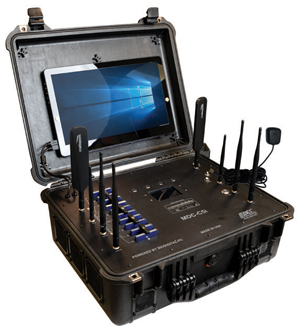
 When traditional infrastructure isn’t an option, ADDC has developed the Mobyl Data Center (MDC). For example, the MDC-C5i, packed into a Pelican case weighing under 35 pounds, houses ten BioDigitalPC® and supports up to 10 terabytes of storage. Drawing less than 300 watts, the MDC-C5i can connect via Wi-Fi, LTE, 5G, or satellite, enabling rapid deployment in disaster response scenarios. In minutes, teams can establish operational data centers and emergency communication systems that support over 7,000 calls simultaneously.
Its flexibility, combined with the ability to run on both AC and DC power, allows the MDC-C5i to be deployed in virtually any environment, providing full data center capabilities and cellular networks where they were once thought unreachable.
Extending to the Edge and Beyond
As ADDC continues to push the envelope, it releases specialized solutions for unique needs. For example, the Gazoo, a wearable tactical computer, meets IP67 and Mil-Spec 810 standards. Weighing just 1.5 pounds, the Gazoo can perform real-time data analytics, process full-motion video, and enable secure communications while attached to a soldier’s vest or a first responder’s gear kit. The integration with Microsoft HoloLens transforms the environment into an augmented reality (AR) training ground, providing real-time data to help users anticipate challenges and make smarter decisions on the fly.
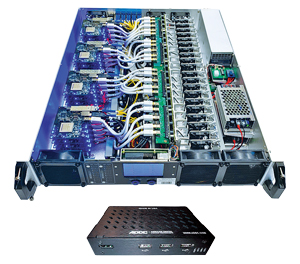 ADDC’s PodCom™ product line takes a different approach by connecting and synthesizing data from sensors in complex systems like military aircraft. Certified with MIL-STD-810, MIL-STD-461, and MIL-STD-704, the PodCom™ is now attracting interest from commercial airlines and industrial IoT sectors, where its ability to uncover insights can drive innovation and improve efficiency.
Sustainability and adaptability are core principles behind every ADDC product. These devices consume a fraction of the power of traditional systems, reducing operational costs while minimizing waste. And because the BioDigitalPC® is modular, users can upgrade their systems by simply swapping out the latest model, avoiding the need for costly and time-consuming system replacements.
ADDC’s design philosophy spans its entire product portfolio, with more than 30 patents granted in areas ranging from wearable technology to portable data centers. By operating at the intersection of cybersecurity, artificial intelligence, and edge computing, ADDC delivers devices that are compact yet powerful, resilient, and energy-efficient—providing a platform for applications that haven’t even been conceived yet.
ADDC isn’t waiting for the future to happen. They’re creating it—one product at a time.
| Share this Article: Tweet
|
Company
Arnouse Digital Devices Corp.
Management
Michael Arnouse, President and CEO
Description
Arnouse Digital Devices Corporation was founded in 2002 by Michael Arnouse to create a revolutionary and environmentally friendly, interchangeable compute platform which gives users an unprecedented level of flexibility, compute power, small size, low power use and ultra-high security.


Manufacturing Technology Insights Weekly Brief
Be first to read the latest tech news, Industry Leader's Insights, and CIO interviews of medium and large enterprises exclusively from Manufacturing Technology Insights
