
THANK YOU FOR SUBSCRIBING
A featured contribution from Leadership Perspectives: a curated forum reserved for leaders nominated by our subscribers and vetted by our Manufacturing Technology Insights Europe Advisory Board.


In a previous article titled "Not Your Parent's Factory Job: Upskilling Key To Digital Manufacturing Success," I discussed the advantages of upskilling the existing base of employees with digital skills.
However, to accelerate the digital factory return on investment, there will be skills that require hiring externally—for example, people with growth mindsets and digital natives.
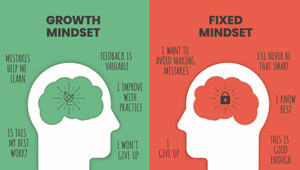
Individuals with a growth mindset believe that their talents can be developed through hard work and learning from setbacks. According to a Harvard Business Review survey, employees with a growth mindset are:
47% likelier to say that their colleagues are trustworthy,
34% likelier to feel a strong sense of ownership and commitment to the company,
65% likelier to say that the company supports risk-taking, and
49% likelier to say that the company fosters innovation.
In contrast, people with a fixed mindset believe intelligence or talent are set traits. As a result, they are highly resistant to change, preventing them from achieving their full potential.
Digital natives are people born with digital technology readily available or in the information age; thus, they are comfortable with and fluent in digital. Digital immigrants are people born before 1980 and need to learn how to live in the digital world. Today, 40% of US employees are digital natives, which will increase as previous generations leave the workforce.
To attract digital natives and growth mindset personnel to work in smart factories, firms need to focus on the following:
Market Today's Manufacturing Facilities:
No longer are factories "dark and dirty" but instead are brightly lit environments where employees engage with technologies such as robots, artificial intelligence (AI), and Internet of Things (IoT) devices. A 2022 Manufacturing Perception Study, from Deloitte and The Manufacturing Institute noted that manufacturers perform the majority (85%) of private sector Research & Development. And advanced manufacturing generates more than 85% of all US patents. Today's factory settings are what digital natives and growth mindset individuals prefer.
"No longer are factories dark and dirty but instead are brightly lit environments where employees engage with technologies such as robots, artificial intelligence (AI), and Internet of Things (IoT) devices."
Continuous Education:
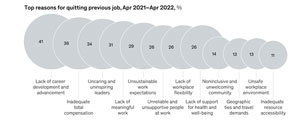
Business processes, as well as technologies, change often. Thus, growth-minded or digital native individuals desire not only frequent training but also one that is consistent with how they prefer to learn. The below chart shows the results of a survey completed by Mckinsey & Company, which highlights that the top reason employees quit their jobs is a lack of career development and advancement.
 Employees are looking for training that aligns with their learning modes. When new processes or technologies are deployed, firms must ensure that varying upskilling options are provided. There are four types of learners: auditory, visual, kinesthetic, and reading/writing. People use a combination of each learning method, but generally, they have a predominant learning style. Since individuals learn differently, a combination of onsite classroom training, online videos, or a hybrid approach that enables students to learn by doing, watching experts, or interacting with peers and teachers should be available for employees.
Flexible Career Paths:
No longer are individuals looking to do the same job as a career. Today, people change jobs every three years.
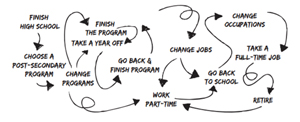 The traditional career path shown in the above chart is no longer relevant. Instead, digital natives and growth-minded personnel align more with a non-linear career path illustrated in the below diagram.
Digital natives and open-minded individuals look for opportunities that not only advance their careers in the same function or industry but also options to explore different areas of work.
Digital upskilling the existing employee pool is key to successfully deploying smart factories. However, externally hiring digital natives and growth-minded individuals will accelerate your investment return. To attract these employees, firms should focus on providing flexible career paths, continuous learning opportunities, and showcasing today's high-tech factory environment.

Manufacturing Technology Insights Weekly Brief
Be first to read the latest tech news, Industry Leader's Insights, and CIO interviews of medium and large enterprises exclusively from Manufacturing Technology Insights
