

THANK YOU FOR SUBSCRIBING


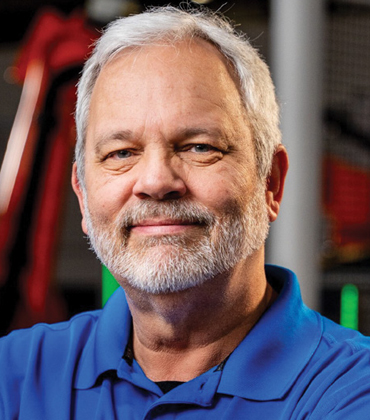 Dean Roberts, President
In robotic palletizing, the real cost of automation isn’t the system itself — it’s the time lost waiting for it to become operational.
Across the industry, installation timelines stretch into days or even weeks. Production slows, teams wait, and the delay begins to impact operations before the system even starts working.
FOCUS Integration was built to challenge that reality.
The company’s approach is direct: automation systems should be installed, deployed, and running in production within one to two days, not a week or more. That principle has shaped every system, every design decision, and every customer engagement since the company’s inception.
“Installation time was a major pain point in the industry,” says Dean Roberts, President. “Our goal was to eliminate that delay and get customers up and running in a day or two, not a week or more.”
Building Complete Systems
How did early industry gaps influence the development of complete system solutions?
FOCUS Integration was founded in 2003 with a different starting point than most automation providers. Rather than building full systems immediately, the company began by supplying end-of-arm tooling and ancillary equipment to robotic integrators.
That early exposure revealed a consistent gap. Many integrators could program robots effectively, but lacked expertise in the surrounding systems — grippers, pallet handling, and material flow. As a result, performance often fell short despite capable robotics.
Within two years, the company shifted direction. Instead of supporting integrations, it began building complete systems — with a clear requirement: every solution had to solve the operational gaps others overlooked.
That shift led to the development of its modular system architecture, which remains the foundation of the company today.
Solutions Designed around Deployment Speed and Operational Simplicity
Why is modular system design important for improving deployment speed and operational efficiency?
At the core of FOCUS Integration’s offering is a family of palletizing solutions designed around deployment speed and operational simplicity.
The Cobalt system, a collaborative palletizing unit, is designed for mobility and rapid setup. It can be positioned within a facility in about an hour and, with power and air connected, can be fully operational within two to three hours.
Across all configurations, the principle remains consistent: reduce deployment time without compromising performance.
Instant Operational Readiness
In what way does pre-shipment testing improve installation reliability and operational readiness?
Speed in deployment is not achieved solely through modular design.
Every FOCUS system is fully assembled, programmed, and tested prior to shipment through a Factory Acceptance Test (FAT). Customers can validate performance using their own products either in person or through a live virtual setup.
All issues are identified and resolved before shipment, ensuring that what arrives on-site is already proven in operation. This eliminates uncertainty at the installation stage and removes the need for extended on-site troubleshooting.
The result is predictable installation timelines and immediate operational readiness.
Ensuring Consistent Operation across Shifts and Teams
Operational simplicity is the second pillar of the company’s approach.
Through its FOCUS Operating System (FOS), complex robotic functions are translated into a user interface that mirrors the simplicity of a tablet. Operators can add new products, adjust pallet configurations, and manage production without requiring programming expertise.
By entering product dimensions and selecting pallet patterns, the system handles the underlying logic automatically.
This reduces dependency on specialized labor and ensures consistent operation across shifts and teams.
Complementing this is LENS, a real-time production monitoring system that provides visibility into uptime, downtime, and throughput. Production managers can track performance at a glance and generate shift-level reports, enabling faster and more informed decisions on the floor.
Reducing Coordination Complexity
FOCUS Integration’s scope extends beyond standalone palletizing systems.
The company delivers fully integrated, turnkey solutions that include upstream and downstream automation. This includes conveyor systems, vertical material handling through spiral conveyors, and integration of autonomous mobile robots for pallet transport.
Rather than functioning as an isolated cell, each system is designed to operate as part of a connected production flow — from line output to final pallet handling and wrapping.
This integrated approach reduces customer coordination complexity and ensures continuity throughout the process.
Improving Reliability and Reducing Downtime
The company’s engineering philosophy is grounded in solving specific operational challenges rather than applying standard solutions.
In the paint industry, for example, traditional palletizing systems relied on vacuum-based handling for five-gallon pails. Variations in suction often led to failures, including spills and system downtime.
FOCUS Integration addressed this by developing a mechanical gripping system that secures containers from the sides rather than relying on vacuum. This eliminated the root cause of the issue, improving reliability and reducing downtime.
The same principle extends across industries. The company designs and manufactures its own end-of-arm tooling — including solutions for boxes, bags, and produce — ensuring each application is engineered to meet its specific requirements.
Shortening the Gap between System Delivery and Production Impact
Since its founding, FOCUS Integration has maintained a disciplined approach to growth. The company has achieved consistent annual growth of approximately 10 to 15 percent, prioritizing long-term performance and customer outcomes over rapid expansion.
“Our focus has never been to be the biggest,” Roberts explains. “It’s to be the best and to maintain a strong reputation in the industry.”
That philosophy continues to guide the company’s direction. As demand for automation increases, FOCUS Integration remains committed to refining its systems, improving deployment speed, and simplifying operation — without adding unnecessary complexity.
In manufacturing, automation is often evaluated by what it can do. FOCUS Integration measures it differently — by how quickly it starts delivering value. By eliminating extended installation timelines and reducing operational complexity, the company enables faster deployment, reduced downtime, and stronger production uptime from the outset.
And in an environment where every hour of production matters, that difference is not incremental. It is operational.
Company
FOCUS Integration
Management
Dean Roberts, President
Description
FOCUS Integration designs modular robotic palletizing systems that are quick to install and easy to run. The company blends smart engineering with practical thinking, helping manufacturers cut downtime, simplify operations, and get production moving faster without the usual complexity that comes with automation.

Manufacturing Technology Insights Weekly Brief
Be first to read the latest tech news, Industry Leader's Insights, and CIO interviews of medium and large enterprises exclusively from Manufacturing Technology Insights
