


THANK YOU FOR SUBSCRIBING


 Claude Maack, CEO
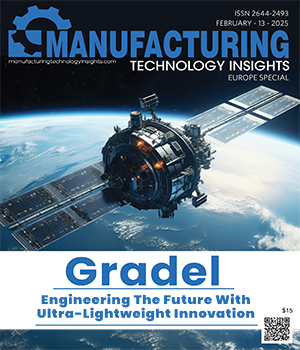
Gradel, a Luxembourg-based engineering company that designs special purpose equipment for Space Industry, is leading this push toward smarter and more efficient lightweight components. For over 15 years, the company has provided solutions for handling, testing, and transporting satellites.
However, recognising the rising demand for ultra-lightweight materials and their transformative potential across industries, Gradel charted a bold course of diversification five years ago. This strategic pivot gave rise to GRAM (Gradel Robotic Additive Manufacturing), a groundbreaking process poised to redefine composite manufacturing. This process sets new benchmarks in lightweight materials’ strength, sustainability, and precision across industries.
“We saw an opportunity to add greater value to components and realised that lightweight solutions were no longer just a priority for space—they are essential across industries,” explains Claude Maack, CEO.
GRAM: A Technological Leap in Lightweight Components
Gradel’s GRAM technology is revolutionising composite manufacturing with its innovative, endless filament winding process. By mimicking bionic structures, GRAM aligns fibres along the natural flow of forces, adhering to the principle of “form follows force.” The GRAM process integrates inserts directly into the winding path, unlike traditional methods involving drilling holes and cutting fibres, compromising structural integrity.
The result is a breakthrough in performance and weight reduction. Components manufactured using GRAM can handle five times the load of state-of-the-art solutions while achieving up to 70% weight savings compared to metal counterparts.
Besides its versatility, GRAM supports many materials, including carbon, basalt, glass, and even renewable fibres like hemp or flax. These fibres can be paired with epoxy resins or customisable resin systems, including bio-based and recyclable options, allowing Gradel to tailor each solution to the specific needs of its applications. Its unique flexibility ensures optimal performance and sustainability through circularity by design, making GRAM a game-changer for industries striving to innovate responsibly.
In industries like aviation, lightweight delivers not just operational savings but also significant environmental benefits. For example, reducing one kilogram of weight on an Airbus A320 can save 100 kilograms of fuel annually, translating to 350 kilograms less CO2 emissions. As airlines prepare for carbon taxes set to take effect by 2026, the ability to cut emissions and operating costs through innovative lightweight solutions becomes increasingly critical.
“Using ultra-lightweight components isn’t just a technical benefit—it’s a business imperative,” Maack emphasises. “The operational savings, combined with environmental impact reductions, make GRAM a transformative process.”
Beyond weight savings, GRAM offers remarkable advantages in terms of cost efficiency. The process reduces material use and delivers a 60 percent improvement in the total cost of ownership (TCO) compared to metal benchmarks, a feat unmatched by competing technologies. For satellite operators, such advancements translate into lower launch costs and the ability to allocate payload capacity more effectively—critical factors in today’s rapidly expanding space economy.
Scaling Through Digital Transformation
Gradel’s ambition doesn’t stop at creating superior components. To accelerate adoption, the company is developing a comprehensive digital process chain integrating topology optimisation, robotic programming, and AI-powered software. This streamlined system transforms the complex journey from concept to manufacturing into a seamless, user-friendly platform, enabling organisations to harness the full potential of lightweight manufacturing with greater ease and efficiency.
By starting with precise engineering inputs—such as work volume, load cases, and interface requirements—Gradel ensures each design is optimised for specific force distributions while minimising material usage. The process then incorporates finite element analysis to predict critical performance metrics, including deformation, stress distribution, and natural frequencies, providing a robust foundation for data-driven decision-making.
Through advanced algorithms and robotic programming, this digital ecosystem automates the creation of winding paths and manufacturing protocols, eliminating the need for extensive manual intervention. Incorporating AI further democratises the process, allowing engineers with limited expertise in finite element analysis or robotics to design and produce high-precision lightweight components. This approach reduces engineering time and expands the accessibility of GRAM technology across industries, making lightweight manufacturing scalable and intuitive for a broader range of users.
Educating the Future Leaders of Industry
Understanding the importance of long-term adoption of its process, Gradel is actively engaging with universities and research centres to build awareness of its technology. By providing winding equipment to academic institutions, Gradel is planting the seeds for a future where lightweight manufacturing becomes second nature to the next generation of industry leaders.
“For the industry to truly evolve, future leaders need to understand the transformative potential of lightweight materials,” explains Maack. He says, “We aim to ensure GRAM becomes a cornerstone of engineering education.”
For Gradel, it’s not just about spreading awareness; it’s about creating a culture of innovation that will ripple through industries for decades.
Proven Success and Industry Recognition
Gradel’s achievements have garnered recognition from industry leaders, solidifying its reputation as a pioneer in lightweight manufacturing. One standout accomplishment is its collaboration with BMW on the BMW M Visionary Material Seat, which utilised Gradel’s GRAM structure. This innovative project earned the Altair Enlighten Award 2024 in the “Sustainable Process” category, presented at the Center for Automotive Research Seminar in Michigan, USA, on August 6, 2024.
This prestigious award underscores the industry’s recognition of GRAM’s transformative potential in achieving both sustainability and efficiency. The award-winning collaboration demonstrated how Gradel’s technology could deliver significant weight reductions while enhancing cost-effectiveness—critical factors in industries under increasing pressure to innovate responsibly.
GRAM’s precision and reliability further underscore its value. With component failure predictions accurate within 5 per cent, Gradel ensures consistent quality across production runs. This level of precision, combined with the flexibility of its patented processes, sets Gradel apart as a trusted partner for industries seeking innovative solutions.
A Future Shaped by Lightweight Innovation
As Gradel continues to refine its technology and scale its operations, the company is poised to lead a revolution in lightweight manufacturing. By integrating AI into the GRAM process and expanding its market reach, Gradel creates a pathway for industries worldwide to embrace lighter, stronger, and more sustainable solutions.
It delivers superior performance and addresses cost, emissions, and resource efficiency challenges. As the demand for lightweight solutions grows, Gradel is proving that innovation and sustainability can go hand in hand, setting the stage for a lighter, greener, and more competitive future.

Company
Gradel
Management
Claude Maack, CEO
Description
Gradel is a Luxembourg-based engineering company that designs and manufactures mechanical ground support equipment. For over 15 years, the company has provided solutions for handling, testing, and transporting satellites.

Manufacturing Technology Insights Weekly Brief
Be first to read the latest tech news, Industry Leader's Insights, and CIO interviews of medium and large enterprises exclusively from Manufacturing Technology Insights
