



THANK YOU FOR SUBSCRIBING
The edge computing landscape is evolving rapidly, driven by an increasing reliance on remote access, real-time analytics, and decentralized infrastructure. Arnouse Digital Devices Corp. (ADDC) is at the forefront of this evolution, delivering ultra-compact, rugged edge computing devices that combine military-grade durability with the energy-efficient and secure technology today’s enterprises demand. Headquartered in Port Washington, New York, with offices on both coasts, ADDC was founded in 2002 by Michael Arnouse. Since then, the company has been a trailblazer in the edge computing space—long before it became a buzzword. “What we offer isn’t just smaller and more efficient— it’s smarter and more secure,” says Michael Arnouse, President and CEO. As businesses increasingly rely on cloud services, the demand for robust, efficient solutions grows. Rising energy costs, expanding security vulnerabilities, and mounting environmental pressures place traditional hardware under immense strain. This can slow operations and expose organizations to significant risks. ADDC’s solutions are specifically designed to tackle these challenges, safeguarding data, optimizing energy use, and ensuring operational control even in the harshest conditions. A Big Idea in a Small Package At the core of ADDC’s innovation is the BioDigitalPC®—a fully functional, credit card-sized x86-64 computer. Representing a paradigm shift in edge computing, this tiny powerhouse packs an impressive punch with Intel i7 quadcore processors, 32GB of DDR4 RAM, and 1TB of NVMe self-encrypting storage. Encased in a proprietary epoxy material, the BioDigitalPC® is tamper-proof, waterproof, dustproof, and free from the constraints of legacy cooling systems. This pluggable device is hot-swappable and designed to perform in environments that would incapacitate traditional systems. With an operational range from -40°C to 70°C, the BioDigitalPC® eliminates the physical vulnerabilities of conventional computers and servers, earning NIST FIPS 140-2 Level 3 validation for its security.

Dennis Hodges, CIO, Inteva Products

Hao Dinh, Vice President of Technology, Enpro

Steven R. Sopher, Executive Vice President, JSP Resins LLC

Bob Jackson, Vice President Of Distribution, PGW Auto Glass

Lirong Bao, Global Science & Technology Director, Aerospace Materials, PPG [NYSE:PPG]

Mark Broadbent, Sr. Avionics Engineer and Katie Gibas, Marketing Communications Manager, Moog Inc

Brent Heller, Head of Manufacturing and Industrials, Amazon Business
The manufacturing sector must shift from a linear to a circular model, prioritizing sustainable practices, green technologies, and eco-design for environmental and economic benefits.
Edge Computing transforms manufacturing by optimizing operations, reducing costs, enhancing quality, and enabling new revenue models, promising substantial ROI despite initial investment challenges.
A New Era of Edge Computing
One of the biggest shifts is the rise of AI at the edge. Companies are deploying lightweight neural networks directly on edge devices such as cameras, sensors, gateways and robots. This move unlocks faster decision-making and more resilient operations, especially for industries like manufacturing, logistics, smart cities and healthcare.
There’s also a surge in edge-native security architectures. Zero-trust frameworks, hardware-level encryption and autonomous threat detection systems are becoming standard features of next-generation edge platforms.
5G and private networks are also accelerating edge adoption. Ultra-low-latency connectivity is enabling new use cases such as autonomous vehicles, remote industrial control, immersive retail experiences, and next-level AR/ VR applications. As edge and 5G converge, the line between cloud and device continues to blur, creating a unified continuum of compute.
This edition of Manufacturing Technology Insights brings recent developments in the edge computing arena and insights into how organizations can adapt to these disruptive trends to deliver transformative experiences.
It features thought leadership articles from industry experts, including Mark Broadbent, sr. avionics engineer and Katie Gibas, marketing communications manager at Moog Inc., who discusses strategies for bridging the gap between speed and resilience for on-orbit computing. Todd Kackley, VP and CIO of Textron, shares his insights into the evolution of manufacturing technology through the years and what lied ahead.
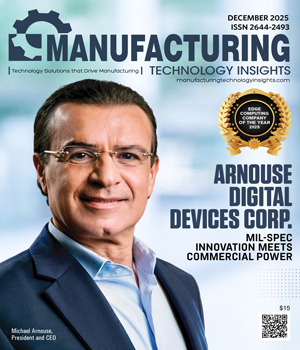
The cover features Arnouse Digital Devices Corp., an edge computing company that designs ultra-compact, rugged edge computing solutions to deliver military-grade durability, high performance, and energy efficiency. Its innovative devices power secure, scalable, and sustainable operations from remote sites to enterprise data centers worldwide.
We hope this edition helps you gain deep insights into the trends and trendsetters transforming the landscape of edge computing in the manufacturing industry.

Manufacturing Technology Insights Weekly Brief
Be first to read the latest tech news, Industry Leader's Insights, and CIO interviews of medium and large enterprises exclusively from Manufacturing Technology Insights
